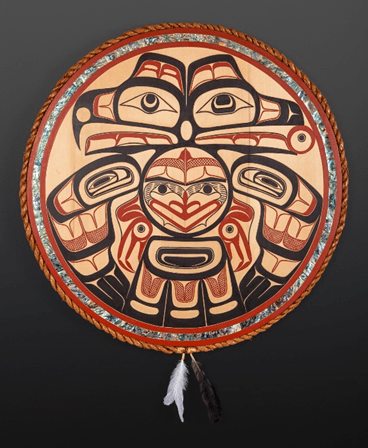
On a day-long boat excursion to the southern islands of Haida Gwaii, we struck up a conversation with a Seattle resident who has spent many summers in Haida Gwaii. On this visit, he put together an introductory tour of the islands for his friends. They had two extra seats on the zodiac and graciously allowed us to tag along. Our new acquaintance spends his vacation-time volunteering in the local community and at the Haida Heritage Centre in Skidegate. He recounted stories of young Haida artists who now live on the mainland in British Columbia or with the thriving Haida community in the Seattle area and recommended we contact Elizabeth Steinbrueck, owner of Steinbrueck Native Gallery (steinbreucknativegallery.com) in Seattle, to learn more.
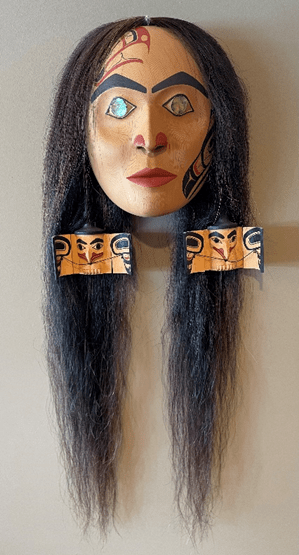
Still in awe of everything we saw and the people we met on Haida Gwaii, we visited Elizabeth at her gallery adjacent to the famous Pike Place Market above Seattle’s waterfront, as soon as we could. Elizabeth guided us through the gallery’s collection of contemporary carved panels, bentwood boxes, ceremonial masks, paddles, and jewelry. Works from renowned Tsimshian carving master David A. Boxley appeared alongside those from up-and-coming artist and Haida Nation member Ernest Swanson. We met several young artists at shows hosted by the gallery and found a similar story — each had dedicated themselves to a lengthy period of apprenticeship under an experienced artist. Training often continued with formal education in visual arts programs. As dedicated artists, many are practicing their skills while continuing to work their fulltime day jobs, many following a parent into commercial fishing. “I’m saving the proceeds from my art to buy my own fishing boat,” was one refrain. Fortunately, for these talented young artists, contemporary Northwest Coast artwork, with the considerable time and skill involved, now commands respectable prices and helps supplement their income while encouraging them to celebrate their heritage.
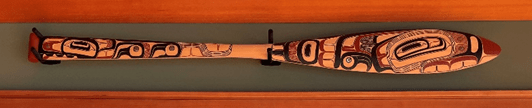
One of the themes we saw often in Northwest Coast Art was “Moon” masks. The monthly and seasonal changing nature of the moon gives it special significance and is often depicted with a female likeness honoring the matriarchal society. Elizabeth Steinbrueck’s gallery commissioned four moon masks from the Tsimshian artist Phil Gray. Phil identified four lunar stages for his four moons, roughly based on the repeating rhythms of nature, growing seasons and harvests.
Phil wanted all four masks to come from a single cedar log, linked in creation as they would be in a new visual existence, and cautioned that finding a suitable cedar log producing four quality blocks for the carvings might take some time. After almost a year and a half, Phil completed the project with the graceful mastery of a seasoned carver.
What follows are photos of Phil Gray’s amazing creations and his explanation of each one:
gooym – Spring Moon
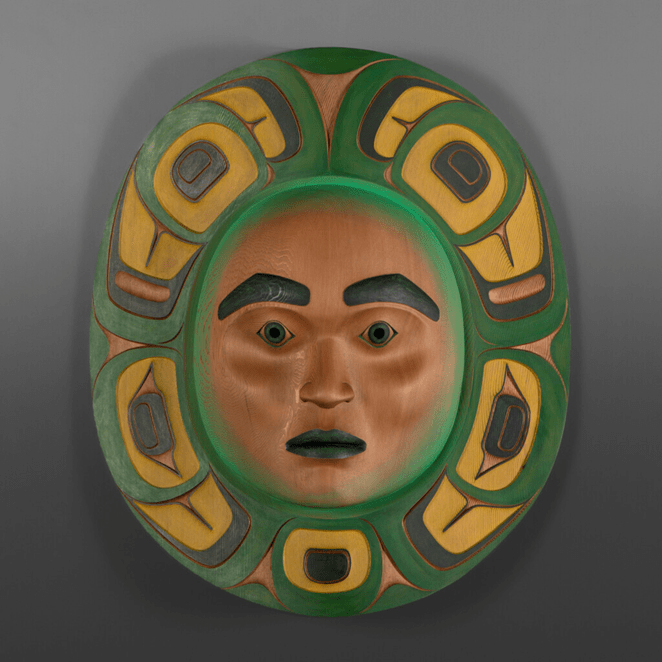
“In Ts’msyen country, Spring is a time for harvesting seaweed and herring eggs. Skunk cabbage is a sign that seaweed is ready to harvest, so I used a few shades of green to depict this, as well as the yellow for herring eggs. The design is a little more abstract, but I tried to get the feeling of seaweed laying on the rocks, which was difficult because they are not long and stringy like I imagined. (Haha!) It’s called purple laver seaweed if you are interested to see what it looks like. For each mask I used an image of Indigenous women I found on google images. Spring makes me think of a fresh start with all of the trees and plants coming to life, a sense of newness, so I used an image of a young indigenous woman from South America for reference.” Phil Gray, Ts’msyen Red Cedar, acrylic paint, 22” x 20” x 8”
suunt – Summer Moon
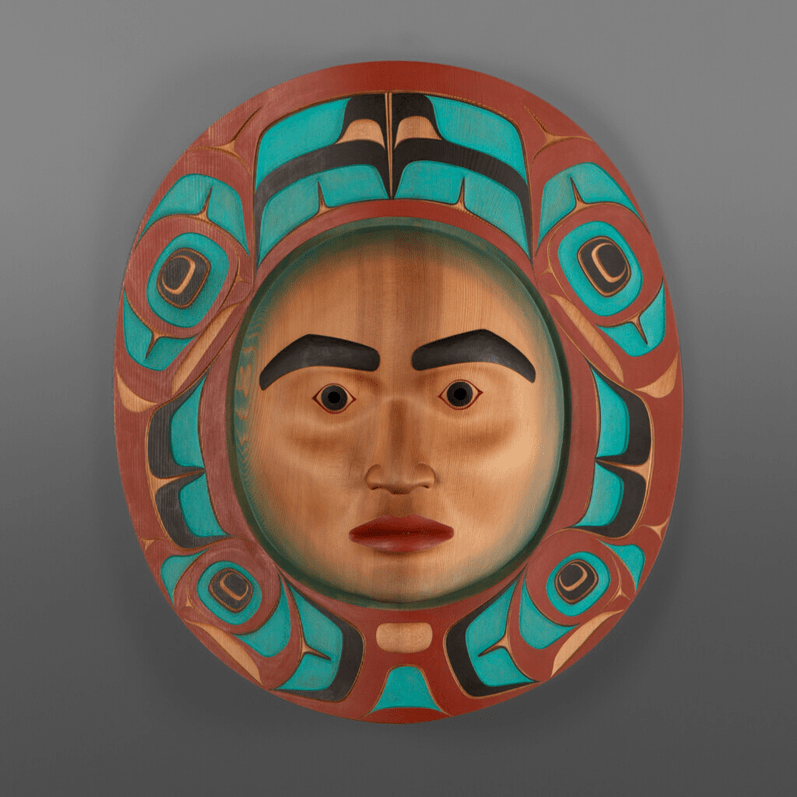
“This is a time for sockeye fishing and berry picking. I used red for the berries and for salmon when they are ready to spawn, which is a theme I liked for this. I thought of the abundance of life and nourishment we receive from the land and water, so I found an image of a young indigenous mother from the 1800’s. Her features were so strong and unique, I really enjoyed using her image as inspiration. The design is Salmon and I used the blue to depict water.” Phil Gray, Ts’msyen Red cedar, acrylic paint 22” x 20” x 8”
ksuut – Autumn Moon

“There wasn’t much I could go off of for what autumn represents in Ts’msyen country because it has more to do with harvesting and feasting. I went with a more common theme for Autumn, such as the vibrant colours of the leaves. The design is also meant to convey the idea of the leaves blowing in the wind. The image I used for inspiration was of an Indigenous woman further along in life, maybe late 30’s or early 40’s. I chose this to go along with the progression of the seasons and to acknowledge that these women are usually the ones that ma ke our feasts/potlatches happen.” Phil Gray, Ts’msyen Red cedar, acrylic paint 22” x 20” x 8”
goomsm – Winter Moon
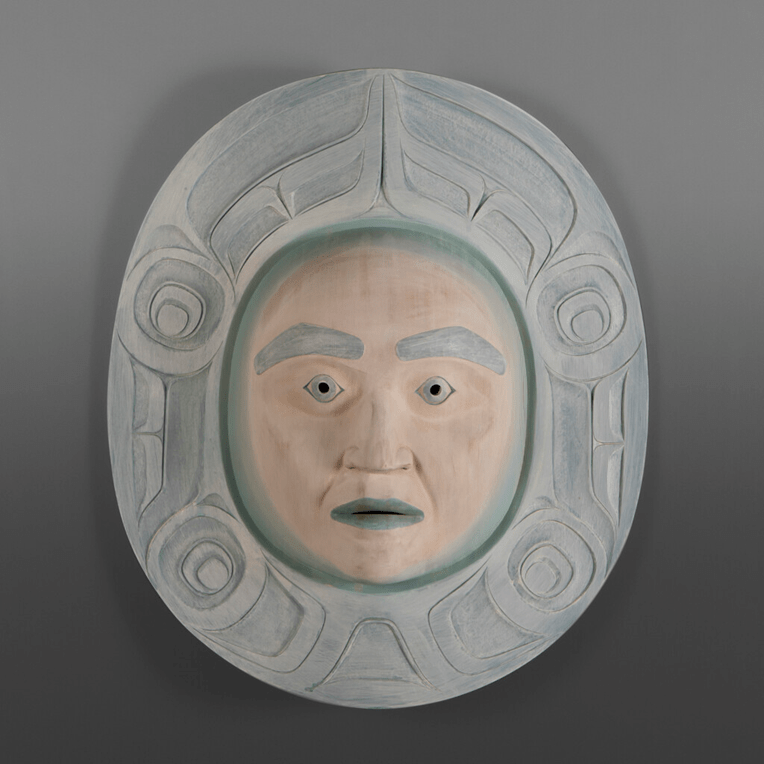
“The colours are fairly clear for winter and the design depicts snow weighing down the branches of a cedar tree, as well as the gusting of the north wind. The winter frosts and frozen rivers create a soft blue colour that is hard to find anywhere else. I used my eldest aunt for inspiration here, because her hair has been almost pure white for a while now and it warms me up to think of her.” Phil Gray, Ts’msyen Red cedar, acrylic paint 22” x 20” x 8”
Phil Gray – Tsmishian & Cree
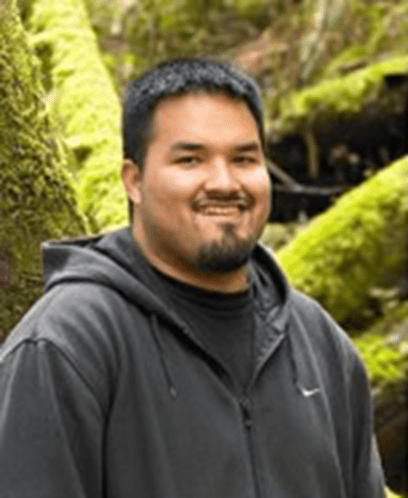
Phil was born in 1983 into the Tsimshian Killer Whale clan. His culture sparked a passion for creating art and he began carving in 1999. Phil works primarily in cedar and alder. He creates masks, panels, poles, sculptures and drums. The majority of his works are created in Tsimshian style. Phil has apprenticed under some great master carvers such as Coast Salish artist Gary Sheena and studied advanced design under Haida artist Robert Davidson. In 2003, three of his pieces were gifted by a collector to the Burke Museum in Seattle, Washington. A few years later in 2007, Phil completed the Northwest Coast Jewellery Arts Program at the Native Education College in Vancouver, B.C. In February of 2010, Phil designed the helmet of gold medal-winning Skeleton racer Jon Montgomery. Montgomery held Phil’s helmet throughout the Olympic awards ceremony. In 2012, Phil was included in the Vancouver Art Gallery’s Shore, Forest, and Beyond exhibition. In 2014, Phil was awarded a BC Creative Achievement Award for his contributions to the province. One of Phil’s pieces was added to City of Seattle’s permanent Public Works Collection in 2015. In 2017, Phil won two major prizes: a YVR Art Foundation Mid-Career Scholarship and a REVEAL Indigenous Art Award, which was issued in celebration of Canada’s 150th birthday.
Phil has established himself as one of the most interesting carvers working today. He is deeply respectful of the past, yet keen to move his art into the future.
2005—Work included in Changing Hands: Art Without Reservation 2, Museum of Art and Design, New York, NY
2009—Work included in Challenging Traditions, McMichael Gallery, Kleinburg, Ontario
2009—Work included in Continuum: Vision and Creativity on the Northwest Coast, Bill Reid Gallery, Vancouver, BC
2012—Works included in two-person show Cranmer + Gray, Kwakwaka’wakw + Tsimshian, Coastal Peoples, Vancouver, BC
2015—Works included in Ongoing Traditions II, Steinbrueck Native Gallery, Seattle, WA
2016—Works included in Ongoing Traditions III, Steinbrueck Native Gallery, Seattle, WA
 CMAdventures
Leave a comment