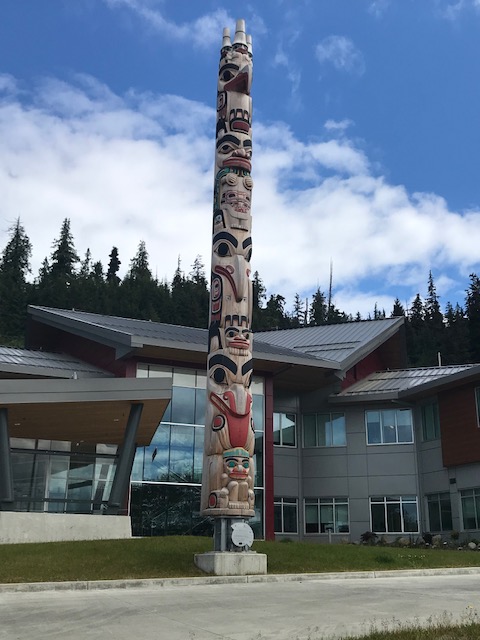
A few years ago Mike started searching for an epic Canadian fishing trip. He found a promising lodge on Haida Gwaii, formerly known as the Queen Charlotte Islands, offering accommodations, meals, and guided fishing. My response to his find was “Where’s that?” Mike admitted he had never heard of the remote island chain and did not know anyone who had been there – significantly adding to the allure of a great adventure. The resulting history lesson on the perseverance of the Haida Nation spawned our appreciation for this resolute culture and the contemporary arts emerging from an ancient yet little known archipelago. Life is an amazing journey with unanticipated directions and unexpected places – welcome to Haida Gwaii.
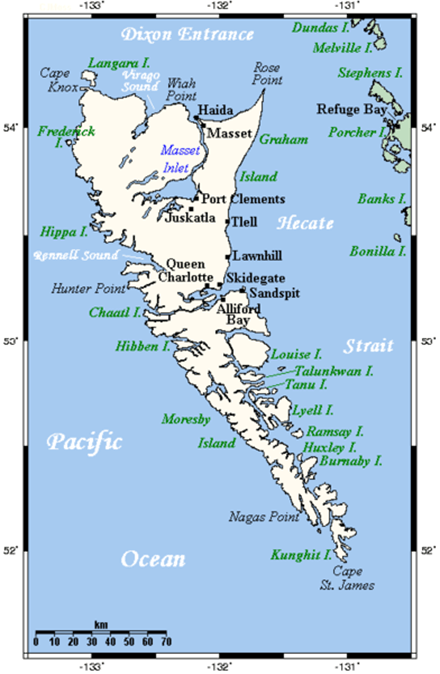
(Wikipedia.org)
Formally recognized by its proper Haida name – Haida Gwaii -in 2010, this archipelago is almost 500 miles north of Vancouver and 70 miles west of the British Columbia coastline. There are two main islands, Graham in the north and Moresby to the south. Without your own ocean-going vessel, the only ways to visit Haida Gwaii are by flying from Vancouver or taking a long ferry ride from Prince Rupert.
Haida Gwaii is the ancestral home of the Haida Nation. Today almost all inhabitants live on Graham Island. The southern islands include Gwaii Haanas, a National Marine Conservation Area Reserve and Haida Heritage Site, and SGang Gwaay UNESCO World Heritage Site at the southern-most end of the archipelago. Haida Gwaii sits on the edge of the Pacific continental shelf astride warm water currents passing the islands in the summer resulting in the area’s phenomenal fishing.
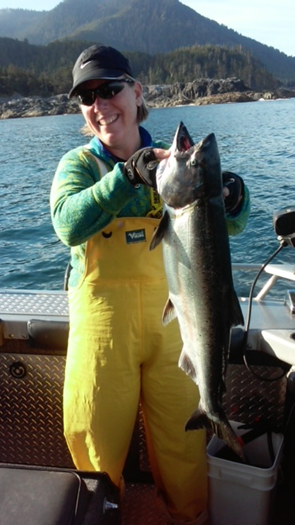
Mike made reservations for early August with Queen Charlotte Safaris (QCS) in the community of Sandspit — three days of fishing and four extra days of accommodations for exploring. We flew into the small airport in Sandspit and were greeted by Valerie Hoperich, the owner and manager of QCS. With a quick ride to the fishing lodge, our adventure began. Valerie was more than happy to have us stay beyond our fishing dates and helped us with tours, transportation, and everything we needed for our explorations. The other thing she did, for which we will be forever grateful, is pair us up to fish with Al and Marsha Sue. The Sues are from Scottsdale, Arizona, and had fished at QCS several times before.
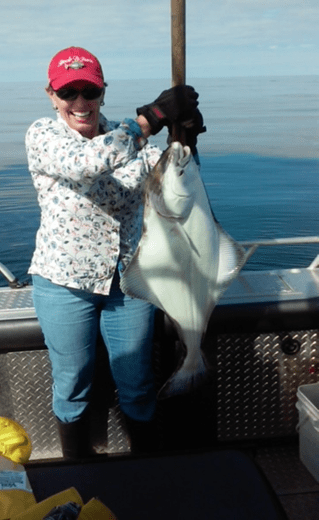
Valerie knew instinctively that our personalities would match; that is just what a good lodge manager does. On this trip, the fishing was extraordinary with the boat reaching limits of King Salmon, halibut, several different types of rockfish, and lingcod. We saw breaching humpback whales, a sunfish that had to be 10 feet across, bald eagles, Black Bears unique to Haida Gwaii, all surrounded by stunningly raw mountain and ocean vistas. It was all that we could have hoped for and more.
During our extra days in Haida Gwaii, we discovered a vibrant community embracing ancient techniques and employing contemporary tools to artistically express life. The Haida Heritage Centre at Kay Unagaay, located in Skidegate, houses a collection of old and new Haida cultural treasures while small galleries throughout the islands offer crafts and artwork for sale. We were entranced by a world of formline art (shapes created by using centuries old tradition). Our Haida awakening was put into clearer context during an all-day waterborne excursion into the southern islands. We visited ancient villages vibrant almost a century ago, before survivors of the Haida Nation moved to several small communities on Graham Island.
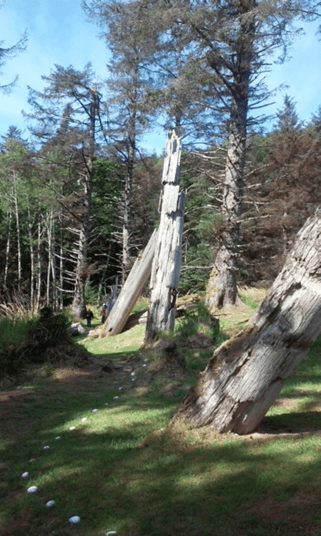
When I say survivors, I mean exactly that. Introduced diseases such as smallpox and typhoid fever brought by European ship crews and traders nearly doomed the inhabitants of Haida Gwaii, reducing the population of the Haida Nation from upwards of thirty thousand to only five hundred in just over a century. The results of near extermination are still felt today among the Haida population. Imagine a community where people have to be cognizant with whom they have personal relationships because of the reduced number of bloodlines.
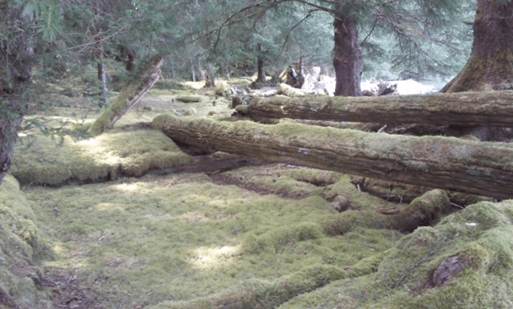
Dugout floor and roof beams are visible.
As the Haida communities were threatened and relocated, whole villages were left vulnerable to looting treasure hunters and western scholars who justified their actions as ‘saving’ Haida artifacts from destruction. Personal and community items were stolen and sold to collectors or removed to museums around the world. Monumental crest poles recording family and clan history, and entire family houses, adorned with paintings and carvings were carted off. Relocated Haida sold or traded precious family heirlooms and ancient artifacts for a pittance simply to survive. Many of these rare pieces ended up in prestigious museums in North America and Europe. Currently the Haida Heritage Centre is engaged in a long-term effort to identify Haida cultural treasures and repatriate as many as possible to the Haida Nation and back home to Haida Gwaii.
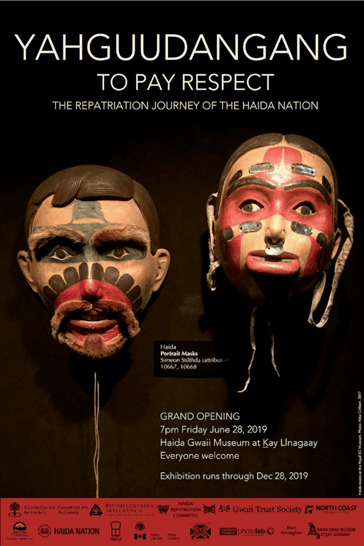
repatriation exhibit poster.
Near extinction and forced assimilation were common experiences all along the Pacific Coast from California through British Columbia to Alaska where nations’ languages, visual expressions of traditions, potlatches and storytelling were banned until the middle of the 20th century. The struggle to regain basic human rights for First Nations and the right to practice traditional life came just barely in time to save some of the ancient processes and knowledge. Today, multiple generations of Haida and other Northwest Coast First Nations are dedicating themselves to relearning their almost-lost language and the techniques for living and maintaining traditional practices. Luckily for us all, interest in connecting to the old ways is strong within the communities.
Next: Our Journey into Northwest Coast Art
 CMAdventures
Leave a comment